Room for Murder Daily › Blog › Knights and Knaves Puzzles with Answers — and the Murder Mystery Version
Knights and Knaves Puzzles with Answers — and the Murder Mystery Version
Ten knights and knaves puzzles with answers — from the classic two-person riddle to murder mysteries where the killer always lies — plus three rules that solve almost any truth-teller and liar puzzle.
- Knights always tell the truth and knaves always lie; from what they say, work out who is who.
- Three rules solve most puzzles: nobody can say "I am a knave"; "X is a knight" means speaker and X are the same kind; "X is a knave" means they're different.
- When the rules run out, assume one person's type and follow the consequences until something breaks.
- Ten puzzles below, answers hidden; the last four are murder mysteries where the killer is a knave.
On a certain island, every inhabitant is either a knight, who always tells the truth, or a knave, who always lies. You meet a few of them, they each say something, and you have to work out who is who. That's the whole game — and it's one of the most elegant logic puzzles ever invented, made famous by the logician Raymond Smullyan in the late 1970s.
Below: the three rules that crack most of these puzzles, ten knights and knaves puzzles from easy to hard (the last four are murders), and how the same idea powers the Sunday liar cases on Room for Murder. Every puzzle was checked by computer — each has exactly one answer.
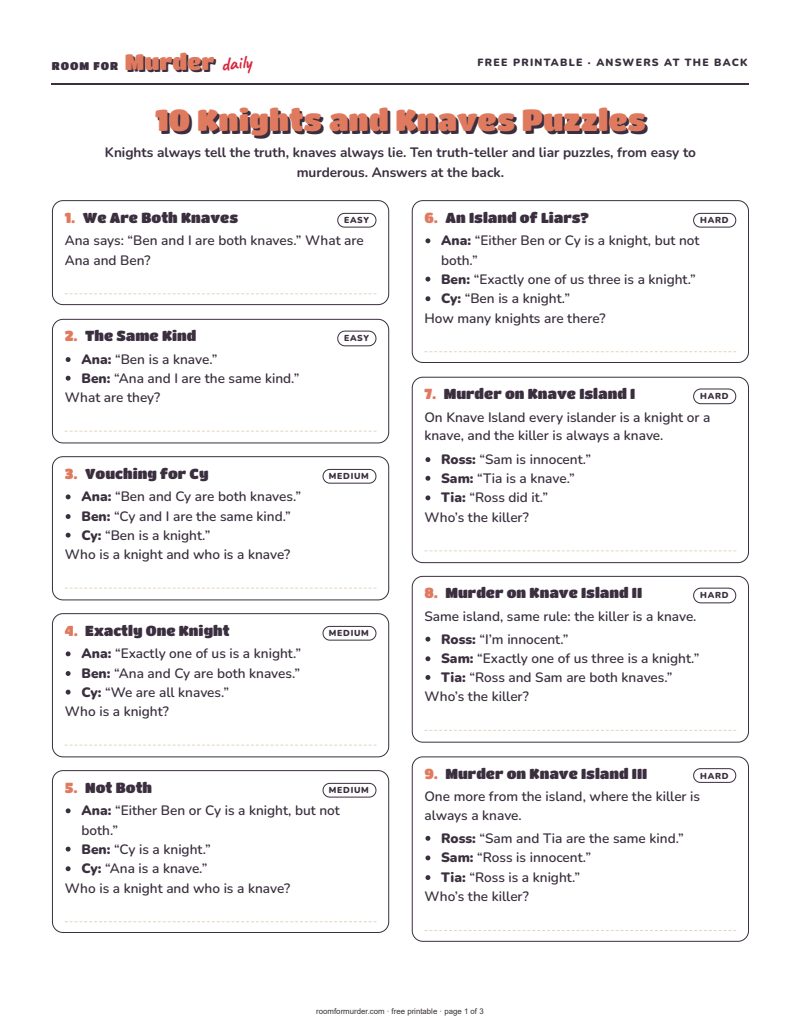 Download the free printable PDFAll 10 puzzles on US Letter, with the answer key at the back
Three rules for any truth-teller and liar puzzle
- Nobody can say "I am a knave." A knight would be lying, a knave would be telling the truth. So "we are both knaves" always comes from a knave.
- "X is a knight" means the speaker and X are the same kind. A knight says it truthfully about a knight; a knave says it falsely about a knave.
- "X is a knave" means the speaker and X are different kinds. A knight calls a knave a knave; a knave calls a knight a knave.
When the rules run out, assume: suppose one person is a knight, follow everything their statement forces, and see whether you hit a contradiction. If you do, they're a knave. It's the same move every time, and it never needs a guess that you can't check.
| The speaker is… | …and the statement is true | …and the statement is false |
|---|---|---|
| a knight | possible | impossible |
| a knave | impossible | possible |
Easy knights and knaves puzzles (1–2)
1. We Are Both KnavesEasy
Ana says: “Ben and I are both knaves.” What are Ana and Ben?
Show the answer
Ana is a knave and Ben is a knight. A knight could never say it (it would make her a knave), so Ana is a knave, and her statement is false: they aren’t both knaves. Ben must be the knight.
2. The Same KindEasy
- Ana: “Ben is a knave.”
- Ben: “Ana and I are the same kind.”
What are they?
Show the answer
Ana is a knight and Ben is a knave. Whatever Ana is, calling Ben a knave makes them different kinds (a knight telling the truth about a knave, or a knave lying about a knight). So Ben’s “we’re the same kind” is false: Ben is a knave, and Ana is the knight.
Medium puzzles: three islanders (3–5)
3. Vouching for CyMedium
- Ana: “Ben and Cy are both knaves.”
- Ben: “Cy and I are the same kind.”
- Cy: “Ben is a knight.”
Who is a knight and who is a knave?
Show the answer
Ana is a knave; Ben and Cy are knights. Whatever Ben is, his statement makes Cy a knight: a knight Ben tells the truth (Cy is like him), a knave Ben lies (Cy is the opposite of a knave). Cy, a knight, says Ben is a knight — true. So Ben and Cy are knights, and Ana’s statement is a lie.
4. Exactly One KnightMedium
- Ana: “Exactly one of us is a knight.”
- Ben: “Ana and Cy are both knaves.”
- Cy: “We are all knaves.”
Who is a knight?
Show the answer
Only Ana. Cy can’t be a knight (a knight can’t call himself a knave), so Cy is a knave and someone is a knight. If Ben were a knight, Ana and Cy would be knaves and Ben the only knight — which would make Ana’s statement true, impossible for a knave. So Ben is a knave, his statement is false, and since Cy is a knave, Ana must be a knight. She’s the only one, just as she says.
5. Not BothMedium
- Ana: “Either Ben or Cy is a knight, but not both.”
- Ben: “Cy is a knight.”
- Cy: “Ana is a knave.”
Who is a knight and who is a knave?
Show the answer
Ana is a knave; Ben and Cy are knights. Ben calls Cy a knight, so Ben and Cy are the same kind. That makes Ana’s “one of them but not both” false — Ana is a knave. Cy calls Ana a knave, which is true, so Cy is a knight, and so is Ben.
Hard puzzles — and murder on Knave Island (6–10)
In the last four, someone has been killed, and the killer is always a knave. That one extra rule turns a "who is who" puzzle into a whodunit.
6. An Island of Liars?Hard
- Ana: “Either Ben or Cy is a knight, but not both.”
- Ben: “Exactly one of us three is a knight.”
- Cy: “Ben is a knight.”
How many knights are there?
Show the answer
None — all three are knaves. Cy calls Ben a knight, so Ben and Cy are the same kind, and Ana’s “one but not both” is false: Ana is a knave. If Ben and Cy were knights, Ben’s “exactly one of us is a knight” would be false. So they’re knaves too, and Ben’s statement is indeed a lie: there are no knights at all.
7. Murder on Knave Island IHard
On Knave Island every islander is a knight or a knave, and the killer is always a knave.
- Ross: “Sam is innocent.”
- Sam: “Tia is a knave.”
- Tia: “Ross did it.”
Who’s the killer?
Show the answer
Tia. If Tia were a knight, Ross would be the killer — so a knave, whose “Sam is innocent” would make Sam a killer too. So Tia is a knave, Sam’s statement is true (Sam is a knight) and Tia’s accusation is false (Ross is innocent). Ross says Sam is innocent — true, since knights aren’t killers — so Ross is a knight. The only knave, and the killer, is Tia.
8. Murder on Knave Island IIHard
Same island, same rule: the killer is a knave.
- Ross: “I’m innocent.”
- Sam: “Exactly one of us three is a knight.”
- Tia: “Ross and Sam are both knaves.”
Who’s the killer?
Show the answer
Ross. If Tia were a knight, Ross and Sam would be knaves and Tia the only knight — making Sam’s statement true, impossible for a knave. So Tia is a knave, and Ross and Sam aren’t both knaves. If Sam were a knave, Ross would be the only knight — again making Sam’s statement true. So Sam is a knight, exactly one of them is a knight, and Ross is a knave: his “I’m innocent” is a lie.
9. Murder on Knave Island IIIHard
One more from the island, where the killer is always a knave.
- Ross: “Sam and Tia are the same kind.”
- Sam: “Ross is innocent.”
- Tia: “Ross is a knight.”
Who’s the killer?
Show the answer
Tia. Tia calls Ross a knight, so they’re the same kind. If both were knights, Ross’s statement would make Sam a knight too — three knights and no knave to be the killer. So Ross and Tia are knaves, Ross’s statement is false (Sam, unlike Tia, is a knight) and Sam’s “Ross is innocent” is true. The killer is the other knave: Tia.
10. The Sunday LiarHard
In a Room for Murder Sunday case, everyone tells the truth except the killer.
- Pell: “Quill did it.”
- Quill: “Pell is lying.”
- Rook: “Quill is lying.”
- Sable: “Rook is telling the truth.”
Who’s the killer?
Show the answer
Quill. Test each suspect as the liar. If Pell were lying, Quill would be honest — but Rook says Quill is lying, so Rook would be a second liar. If Rook were lying, Sable (who vouches for Rook) would be lying too, and if Sable were lying, so would Rook. Only Quill works: Pell rightly names him, Rook rightly calls him a liar, and Sable rightly backs Rook.
From knaves to killers: the Sunday liar
Room for Murder Daily is a free floor-plan murder mystery: every suspect makes one statement, you place them all on the plan (one person per row and column), and the killer is whoever was alone in a room with the victim. Monday to Saturday, every statement is true.
On Sundays, the killer lies. It's the knights-and-knaves idea with one knave: everyone else is a knight. You solve it exactly like puzzle 10 — take each suspect in turn, flip their statement ("beside the piano" becomes "not beside the piano") and try to fill in the plan. Every wrong choice runs into a dead end; only the killer's lie leaves a complete, consistent plan. Every past Sunday case has a step-by-step solution on its page in the archive.

Room for Murder Daily
A new floor-plan murder mystery every morning: place the suspects, find who was alone with the victim. No sign-up, works on phones.
Play today's caseMore logic puzzles
- How to solve a murder sudoku: twelve techniques, from Monday to the Sunday liar.
- 25 murder mystery riddles with answers: quick clue riddles and logic whodunits.
- Free printable murder mystery puzzles: every daily case as a PDF with its solution.
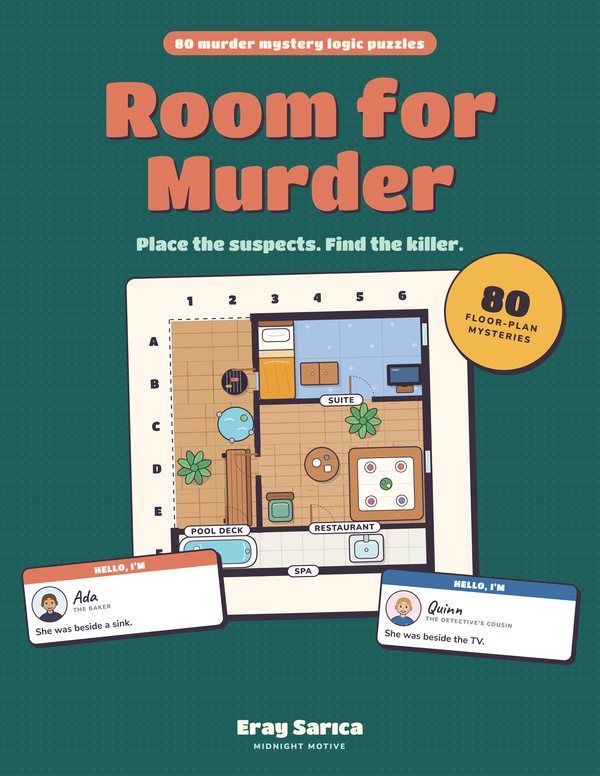
Room for Murder
80 floor-plan murder mysteries in five chapters, from cosy cottages to a lying-killer finale — the book behind this site.
Solo or together
See it on EtsyQuestions people ask
What is a knights and knaves puzzle?
A logic puzzle set on an island where every inhabitant is either a knight, who always tells the truth, or a knave, who always lies. You're given a few statements and have to work out who is a knight and who is a knave. The genre was made famous by the logician Raymond Smullyan in the late 1970s.
How do you solve knights and knaves puzzles?
Assume one person is a knight, follow what their statement forces, and see whether everything stays consistent; if it breaks, they're a knave. Shortcuts help: a person who says another is a knight is the same kind as them, and a person who calls another a knave is the opposite kind.
Can anyone say "I am a knave"?
No. A knight would be lying and a knave would be telling the truth — both impossible. That's why the statement "we are both knaves" is such a useful first puzzle: the speaker must be a knave, and the statement must be false.
What is a liar puzzle in Room for Murder?
On Sundays, one Room for Murder suspect is lying — the killer — and everyone else tells the truth. You test each suspect as the liar: flip their statement and try to fill in the floor plan. Every wrong guess runs into a contradiction; only the killer's lie leaves a complete plan.
Keep reading
- 25 Murder Mystery Riddles with Answers (Short Whodunits for Adults)
- Games Like Murdoku — 8 Murder Sudoku and Deduction Games to Play Next
- Free Printable Logic Puzzles for Adults (Murder Mystery Edition)
We make the games mentioned in this guide — that's why we know them well. Links to Etsy go to our own shop, Midnight Motive.