Room for Murder Daily › Blog › How to Host a Murder Mystery Party (Step-by-Step Guide)
How to Host a Murder Mystery Party (Step-by-Step Guide)
Everything a first-time host needs — choosing a game for your group size, invitations, costumes, food, running the rounds and the big reveal — with a three-week timeline.
A murder mystery party is a dinner party with a plot. Every guest arrives as a character, everyone has something to hide, and by the end of the night the group has to work out who did it. You don't need acting talent, a big house or a big budget. You need the right game for your group, a little preparation, and one evening.
This guide walks you through it in the order you'll actually do things.
1. Count your guests first, then pick the game
The single most common reason a murder mystery night falls flat is a game that doesn't fit the group. Before you fall in love with a theme, decide roughly how many people are coming:
| Group size | What works best |
|---|---|
| 2–4 | A case file — a puzzle everyone solves together at the table, no roles needed |
| 4–8 | A dinner-party game with a character for every guest |
| 8–14 | A bigger party game, ideally one that scales and lets late arrivals join |
| 15+ | A party game plus an expansion pack, or a mingle-style game where people move around |
Look for games that list a range of players (for example 6–10) rather than one fixed number. Somebody always cancels, and a good game tells you which characters to drop and how the clues are redistributed when they do.
Two more things worth checking before you buy:
- Can the host play? In the better games the solution is sealed away from the host guide, so you get to solve the crime too instead of just reading lines.
- Does every role work for any gender? It saves a lot of awkward casting if each character comes with both a male and a female name.
2. Choose a theme your guests will dress up for
The theme is what people talk about afterwards, and it decides the costumes, the playlist and the food. A few that never fail:
- 1920s speakeasy — the classic. Flapper dresses, braces and flat caps, jazz, gin cocktails in teacups.
- Halloween — everyone already owns half a costume. Spooky, but keep it campy rather than gory if teenagers are coming.
- Victorian Christmas — candles, carols, a roast and a ghost story. Lovely for families.

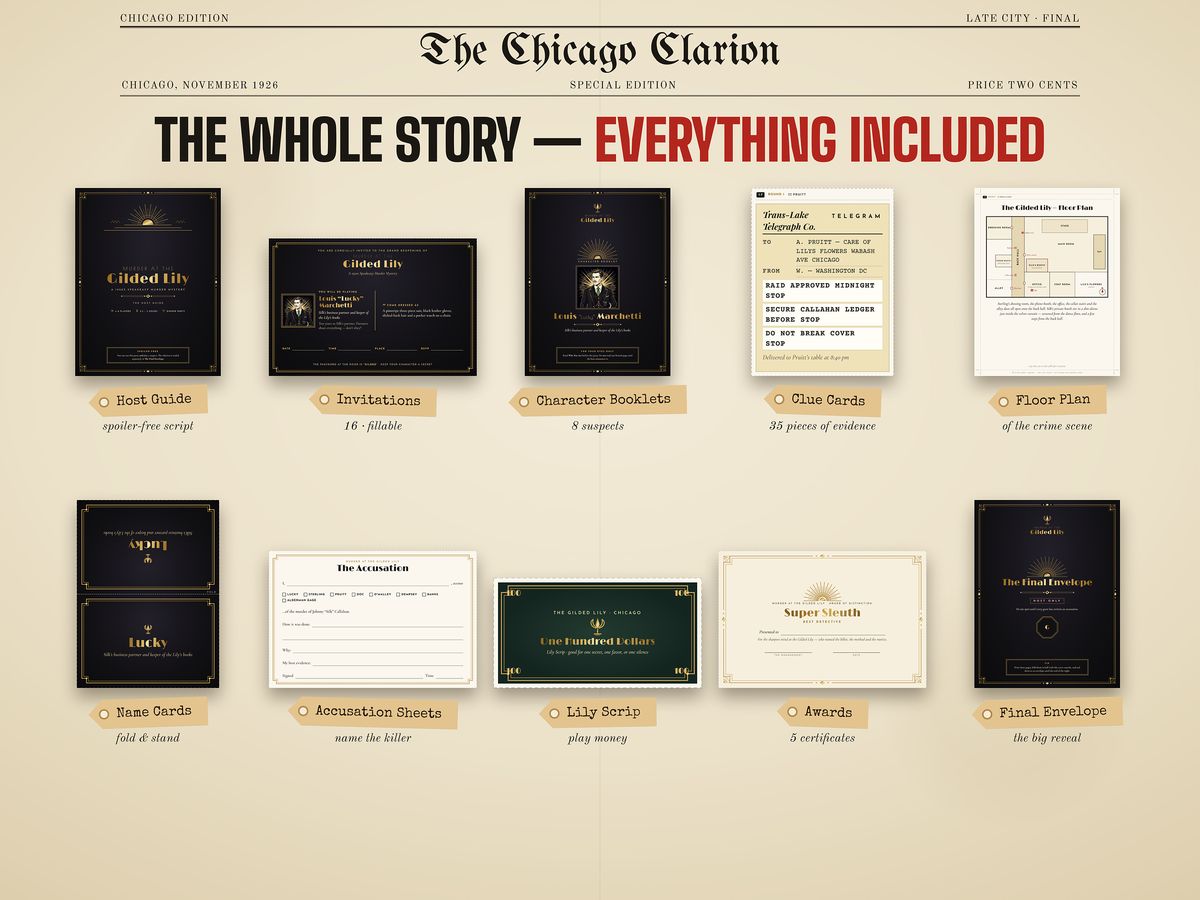
Murder at the Gilded Lily
Chicago, 1926: the reopening night of a gold-leaf speakeasy. Made for intimate dinner parties; the host can play too.
4–8 players (14 with the expansion)
See it on EtsyHosting twenty colleagues or a whole extended family? Choose a mingle-style game, where clues are traded in small groups instead of read out at one table.

Spirit Seekers Live: Dead on Air
Halloween 2006: a live ghost-hunting TV special at a haunted hotel goes horribly wrong. Built as an office-safe mingle game for big groups.
8–20 players, 14+
See it on Etsy3. Send invitations (three weeks before)
Send invitations about three weeks ahead — two weeks for a casual group, a month around the holidays. A good invitation does three jobs:
- Tells each guest who they are playing (just the name and a one-line description — no secrets yet).
- Gives the date, time and address.
- Sets the dress code: a costume idea for their character is the single best way to get people excited.
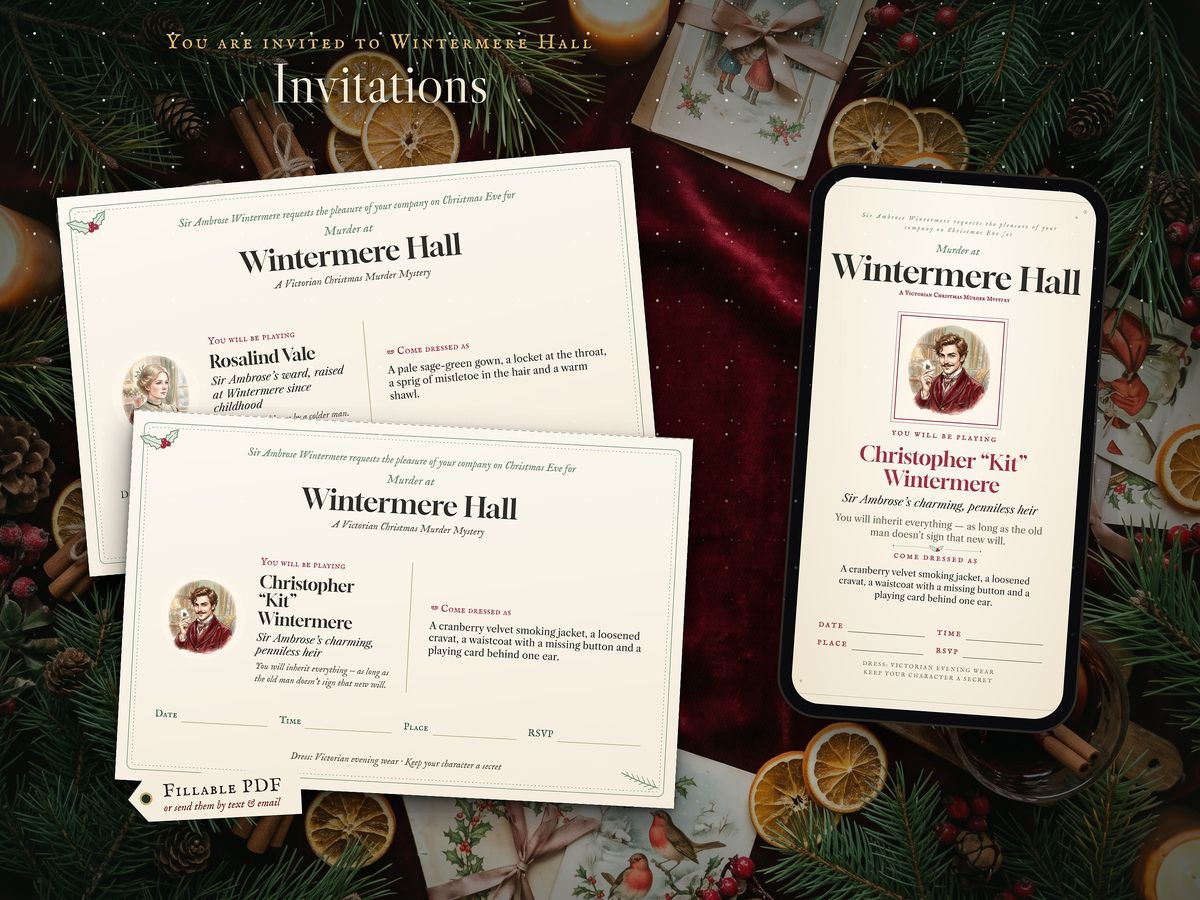
Many printable games include fillable invitations — you type the date and address once and every card updates — plus digital versions you can send by text. Ask everyone to RSVP within a week so you can finalise the cast.
4. Cast the characters (two weeks before)
Once you know who's coming, match people to parts:
- Give the chattiest guests the characters with the most to say, and quieter guests the observers.
- Avoid casting couples as each other's secret rivals unless you know they'll enjoy it.
- Keep a backup plan for one or two no-shows: note which characters are optional.
Don't send the full character booklets in advance. Players read them at the party, round by round — it keeps secrets secret and nobody has homework.
5. Print and prepare (the week before)
Print everything a few days early, not on the afternoon of the party. You'll usually need:
- The host guide (read it all the way through once — it takes 20 minutes)
- One character booklet per guest
- Clue cards and evidence props — cut these out and sort them by round
- Name tags, accusation sheets and, if the game has one, a sealed final envelope with the solution
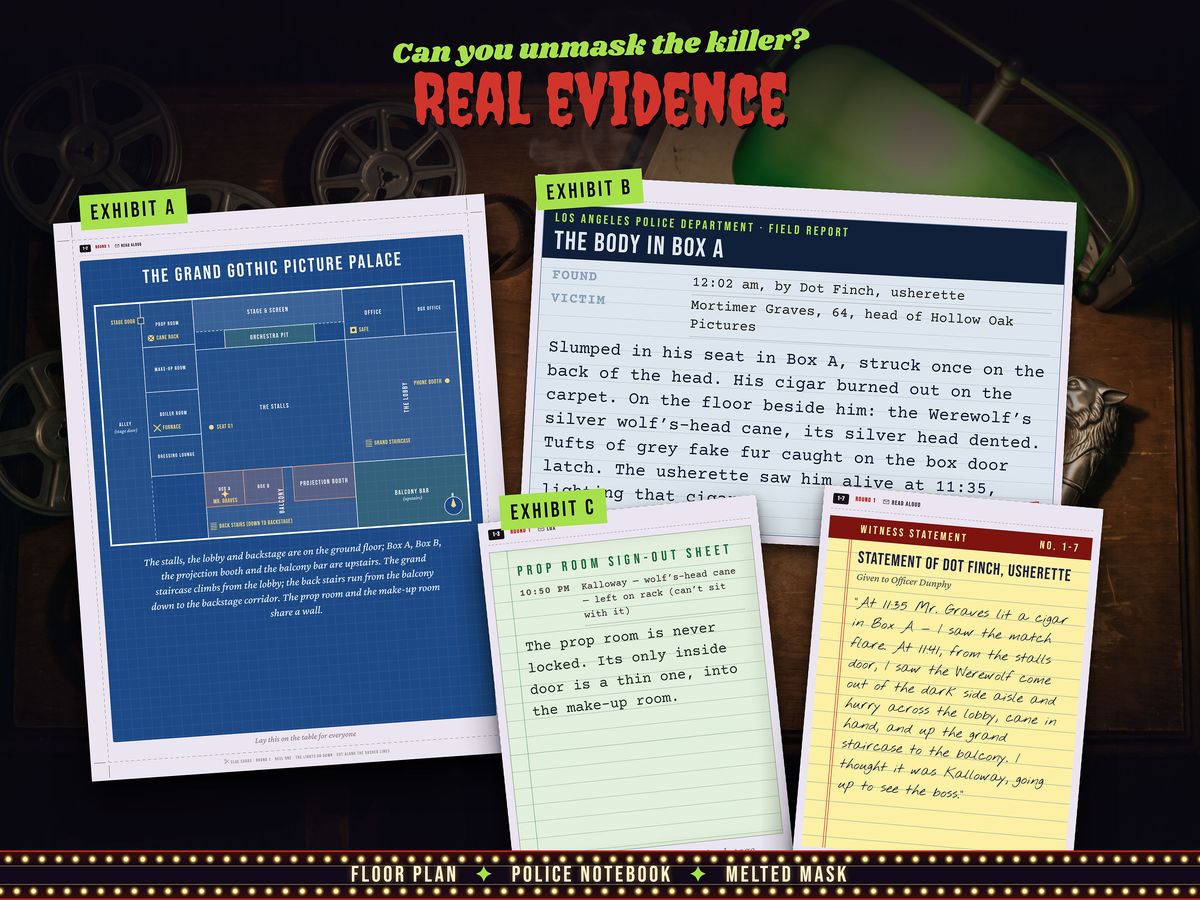
If ink is a worry, look for a printer-friendly version — many games include one with white backgrounds that uses a fraction of the ink. Print the props in colour and the booklets in black and white.
6. Set the scene
You don't need to redecorate. Three things do most of the work:
- Lighting: turn off the overhead lights; use lamps, candles or fairy lights.
- Music: a playlist from the period (1920s jazz, 1950s horror-movie scores, Victorian carols) running quietly all night.
- One prop at the door: a "crime scene" sign, a guest book, or a tray of drinks with name tags.
7. Plan the food around the game
Murder mystery games run in rounds (usually three or four, about 20–30 minutes each). Plan food that fits between them:
- Arrival: a welcome drink and something to nibble while people find their name tags.
- Round 1 → main course: serve the main meal after the first round, when everyone has met and the gossip has started.
- Final round → dessert: bring dessert out just before the accusations — it gives people something to do with their hands while they argue.
Buffet-style or one-pot dishes work best, so the host isn't stuck in the kitchen during the best scenes.
8. Run the night
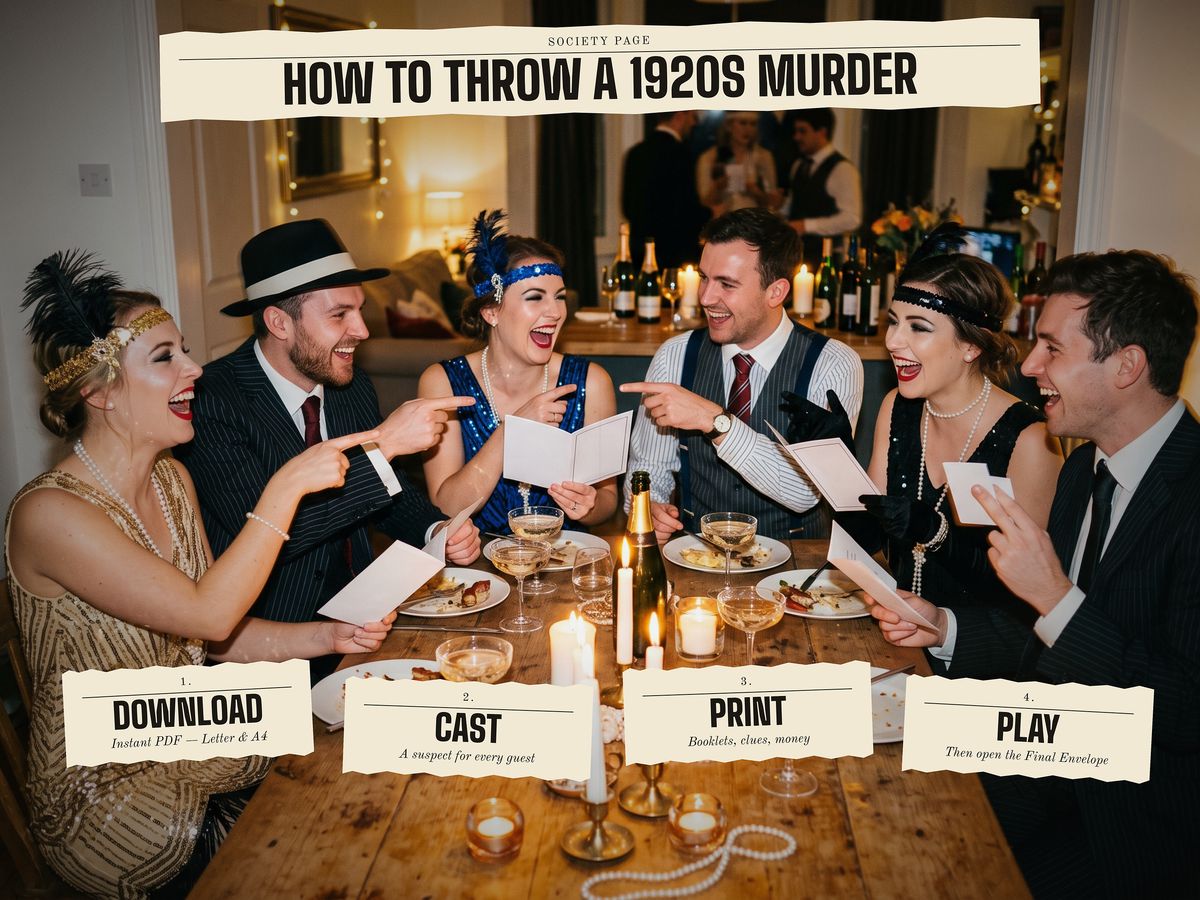
A typical evening looks like this:
- Arrival (20 min) — drinks, costumes, introductions. Each guest reads the first page of their booklet.
- The murder — the host reads the opening scene. Someone is dead; nobody may leave.
- Rounds 1–3 (60–90 min) — in each round players read a new page, share some information, hide some, and new clue cards come into play.
- Accusations (15 min) — everyone writes down who they think did it, how and why.
- The reveal (10 min) — open the final envelope and read the solution aloud. This is the moment everyone remembers.
As host, your only real job is keeping time. When conversation starts to die down, move to the next round.
9. Finish with awards
Hand out a few small awards after the reveal — Best Costume, Best Liar, Best Detective, Most Dramatic Death. Printed certificates cost nothing and people genuinely keep them.
Common first-timer mistakes
- Too many guests for the game. Pick a game that fits, or add an expansion.
- Reading the solution "just to check". Don't. If the game lets the host play, play.
- No time limit on rounds. Use your phone timer.
- Sending booklets in advance. Secrets leak and people forget them anyway.
- Serving dinner during the reveal. Food first, verdict last.
Not ready for a whole party?
If you'd rather try the format with two or three people first, a case file is the gentle way in: a single puzzle you solve together at the kitchen table in an evening, no roles or costumes needed. Or warm up with our free daily case below — it takes ten minutes.

Room for Murder Daily
A new floor-plan murder mystery every morning: place the suspects, find who was alone with the victim. No sign-up, works on phones.
Play today's caseWe make the games mentioned in this guide — that's why we know them well. Links to Etsy go to our own shop, Midnight Motive.